What Is an AI Website Voice Assistant? Giving Your Website a Voice
Your website may already have the answers, but that does not mean your visitors can easily find them. That is one of the biggest problems with business websites today. A company can spend thousands of dollars building a professional website. They may pay for SEO, blogs, landing pages, social media, paid ads, local search, Google Business Profile work, and ongoing updates. All of that work is meant to do one thing: bring the right visitors to the website. But what happens after they arrive? Do they know where to click? Do they find the information they came for? Do they understand your services? Do they know what step to take next? Do they get frustrated on mobile? Do they leave without ever contacting you? For many businesses, the painful truth is this: getting visitors to your website is only half the job. Helping them take action is the other half. That is where a new category is starting to emerge. It is called an AI Website Voice Assistant. At AI WebVoice Canada, we believe this may become one of the next important shifts in how businesses engage website visitors. Not because it is flashy. Because it solves a real problem.
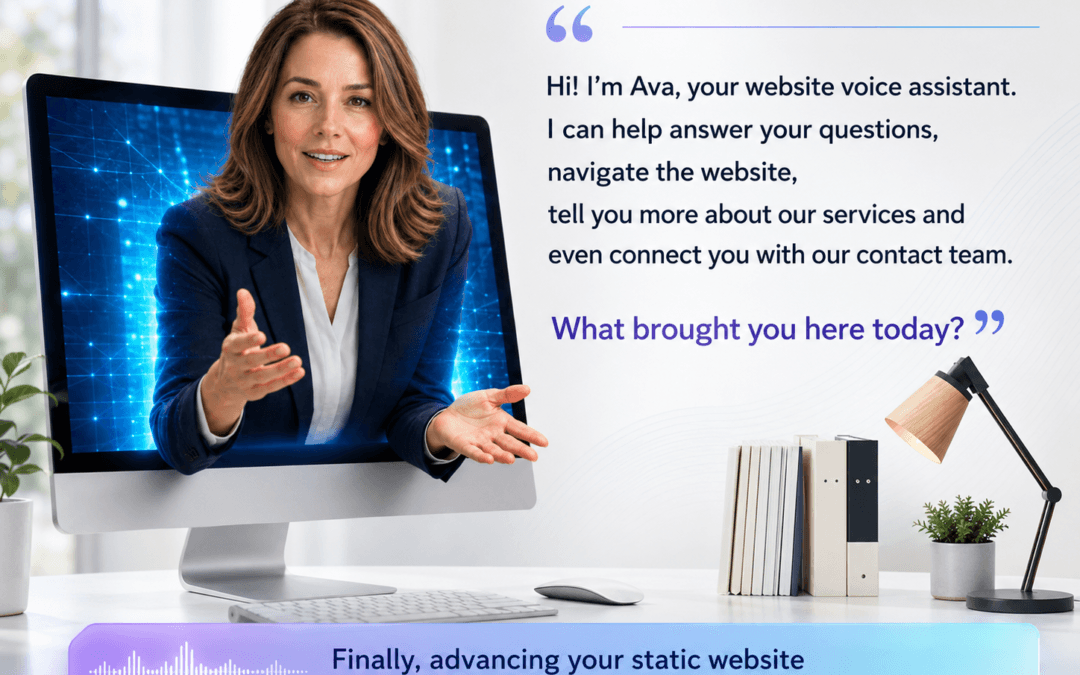
Why not try it for yourself! Look for AVA on this page and go ahead and engage with her!
The Problem: Most Websites Are Still Static
Most websites are still built like digital brochures. They explain who you are, what you offer, where you are located, and how someone can contact you. That is important, but it still puts most of the work on the visitor. The visitor has to read through pages, open menus, scroll through long content, search for pricing or booking information, compare services, find the right contact path, decide whether you are the right fit, and fill out a form before they may be ready. That may sound simple to the business owner, because the business owner knows the website. The visitor does not. They may be on your site for the first time. They may be distracted. They may be on their phone. They may be comparing you with three other businesses. They may be looking for one specific answer and not know where to find it. And if the answer is not easy to find, they may leave. Not because they were not interested. Because the website experience did not help them enough.
Mobile Navigation Makes the Problem Worse
A website may look great on a desktop, but many visitors are not sitting at a desk. They are on a phone. That matters. Mobile visitors often deal with small menus, hidden drop-downs, long scrolling pages, buttons that are easy to miss, buried contact links, forms that feel awkward to complete, pages that require too much reading, and content that is useful but hard to navigate. This is especially true for businesses with a lot of information on their site.
- A bed and breakfast may have rooms, rates, policies, amenities, packages, local attractions, booking pages, and FAQs.
- A winery may have tastings, tours, events, wine club details, private bookings, restaurant information, online store links, and location details.
- A real estate professional may have buying, selling, downsizing, neighbourhood pages, listings, blogs, guides, testimonials, and contact forms.
- A professional service business may have several services, pricing models, intake questions, case examples, and process pages.
The information is there. But can the visitor find it quickly enough? That is the question.
Website Traffic Does Not Always Mean Website Success
Many businesses look at website traffic and assume they are doing well. More visitors sounds like progress. But website traffic alone does not tell the full story. A visitor can spend three minutes on your website because they are interested. They can also spend three minutes because they are confused. That difference matters.
Analytics may show page views, visitor counts, bounce rate, average engagement time, traffic source, and device type. But analytics often do not tell you the question the visitor had before they left. They do not always tell you what the visitor could not find, what confused them, why they did not contact you, what service they were really interested in, whether they were ready to buy, book, call, or inquire, or what information was missing from your website. That is where website owners are often left guessing. You may know people visited your site. But you may not know what they experienced.
The SEO and AEO Challenge
Businesses are now creating more website content than ever. They are writing blogs, building landing pages, answering FAQs, targeting local keywords, and preparing for AI search. That work is important. Search Engine Optimization, or SEO, helps people find your website through Google and other search engines. Answer Engine Optimization, or AEO, helps your content become easier for AI tools and answer-based search systems to understand. But more content can create a new problem. The business wants to rank. The visitor wants an answer. Those are not always the same thing.
A site may have excellent SEO content, but still be difficult for a visitor to navigate. A visitor may land on a blog post, read part of it, and then wonder what to do next. They may ask themselves: does this business help with my situation? Where is the service page? Is there pricing? Do they serve my area? How do I book? Should I call or complete a form? What happens after I reach out? If the website does not guide them, the traffic may not turn into meaningful action. SEO and AEO help bring people to the website. An AI Website Voice Assistant helps them engage once they arrive.
Pop-Ups and Contact Forms Are Not Enough
For years, businesses have tried to solve website conversion problems with pop-ups, contact forms, chat boxes, and chatbots. Some of these tools can help, but many interrupt the visitor too early. A visitor lands on the website and is quickly asked to subscribe, book now, fill out a form, request a quote, enter an email, provide a phone number, or start a chat. The problem is timing. Not every visitor is ready to give personal information right away. Some visitors need answers first. Some need to understand your services. Some need to compare options. Some need reassurance. Some simply want to know whether they are in the right place.
A typical contact form captures people who are already ready. A voice assistant helps people become ready.
That is an important difference. A forced form says, “Tell us who you are before we help you.” An AI Website Voice Assistant says, “Tell me what you are looking for, and I will try to guide you.” That is a more natural experience.
What Is an AI Website Voice Assistant?
An AI Website Voice Assistant is a voice-enabled assistant that lives on your website and helps visitors interact with your content in a more natural way. Instead of expecting visitors to click around on their own, the assistant allows them to ask questions by voice. The assistant can then respond using information from your website content and guide the visitor toward the right page, answer, booking option, service, or contact path. In simple terms, it gives your website a voice. It does not replace your website. It helps people use your website better.
What Can an AI Website Voice Assistant Do?
Depending on the setup, an AI Website Voice Assistant can help your website visitors ask questions in plain language, receive answers from your website content, understand your services, compare options, navigate to the right page or section, ask follow-up questions, learn what step to take next, request contact, book a call or appointment, submit lead information, and interact outside normal business hours.
For the business, it can also help reveal what visitors are asking, where visitors may be getting confused, which services attract interest, what content may be missing, what questions should become FAQs, which calls to action may need improvement, and what visitors are saying before they become leads. That last point is powerful because it turns website visitors into a source of insight.
Current Website Model vs. AI Website Voice Assistant
| Current Website Experience | AI Website Voice Assistant Experience |
|---|---|
| Visitor has to search for answers | Visitor can ask questions directly |
| Menus and pages do most of the work | The assistant helps guide the visitor |
| Contact forms appear before trust is built | The assistant helps first, then asks when appropriate |
| Business sees traffic numbers only | Business can review real visitor conversations |
| Visitors may leave without explanation | Visitor questions can reveal content gaps |
| Mobile navigation can be frustrating | Voice guidance can reduce navigation friction |
| Chatbots often feel scripted | Voice interaction can feel more natural |
| Website is mostly passive | Website becomes more conversational |
This is why the category matters. It is not only about adding AI. It is about improving the visitor journey.
Pros and Cons of an AI Website Voice Assistant
Like any website tool, an AI Website Voice Assistant is not magic. It has real advantages, but it also needs to be used properly.
Pros
- It helps visitors find answers faster because they can ask what they need instead of searching through menus and pages.
- It supports mobile users because voice guidance can be helpful when mobile navigation feels awkward or frustrating.
- It works 24/7, allowing visitors to ask questions after hours, on weekends, or whenever they are researching.
- It can improve lead capture by inviting the visitor to leave contact details when the conversation shows intent.
- It can reduce reliance on pop-ups by creating a more natural engagement path.
- It can reveal better content ideas because visitor questions can show what your website should explain more clearly.
- It can support SEO and AEO strategy because repeated visitor questions may become useful FAQ, blog, or service-page content.
Cons
- It needs quality website content. If your website does not clearly explain your services, the assistant has less useful information to work with.
- It still needs human follow-up. If a visitor becomes a lead, someone from the business still needs to respond.
- It should not replace proper website design. The assistant improves the experience, but it does not fix a poorly planned website by itself.
- It needs monitoring. Conversation history should be reviewed so the assistant can be improved over time.
- It may not be needed for every website. A very simple one-page website with low traffic may not need a voice assistant yet.
This is why the best approach is not just installation. It is setup, testing, review, and improvement.
Why Conversation History May Become One of the Biggest Benefits
Most businesses want leads. That makes sense. But the conversation history may be just as valuable. When visitors use an AI Website Voice Assistant, their questions can help the business understand what people actually care about. For example, visitors may ask: do you offer this service in my area? What does this cost? Can I book online? Is this available on weekends? What is included? Do you help with custom requests? How do I speak with someone? What makes you different? What happens after I contact you?
If several visitors ask the same thing, that is a signal. Maybe the website needs a better FAQ. Maybe a service page is unclear. Maybe the call to action is buried. Maybe pricing or process information needs to be easier to find. Maybe the mobile experience needs improvement. That means an AI Website Voice Assistant can help with more than lead capture. It can help guide future website development, content planning, SEO, AEO, and conversion strategy.
Who Is a Good Fit for an AI Website Voice Assistant?
This type of tool may be useful for businesses where visitors need to understand, compare, book, ask, or inquire before taking action. Good examples include bed and breakfasts, wineries, wine tour companies, event venues, tourism businesses, restaurants with event or private dining options, real estate professionals, home care companies, retirement residences, financial planners, legal services, health and wellness providers, consultants, contractors, education and training providers, professional service firms, and businesses with several service pages or packages.
The common factor is not the industry. The common factor is visitor uncertainty. If your visitors usually have questions before they call, book, buy, or complete a form, this may be worth testing.
Who May Not Be Ready Yet?
An AI Website Voice Assistant is not the right fit for every website. It may not be ideal if your website has very little content, you have no meaningful website traffic, your business has no clear call to action, no one is available to follow up on leads, your services are not explained well, your website is outdated or incomplete, or you are not interested in reviewing visitor conversations.
A stronger fit is a business with more than 100 monthly website visitors, several pages or service sections, useful content or FAQs, clear service descriptions, regular customer questions, booking, inquiry, or contact goals, a desire to improve website engagement, and someone available to follow up. A voice assistant works best when it has useful content to work with and a clear business goal.
Introducing AI WebVoice Canada
AI WebVoice Canada is being developed as a Canadian pilot project for businesses that want to test what happens when their website becomes more conversational, more helpful, and more capable of guiding visitors toward action. The goal is not to replace your website. The goal is to help visitors use your website better.
AI WebVoice Canada is designed to help website visitors ask questions, receive answers from your website content, navigate to relevant information, understand your services, move toward a clear next step, and become better-qualified leads. For the initial pilot, we are looking for a small number of businesses that already have website traffic, useful content, and an interest in improving visitor engagement and lead capture.
What the AI WebVoice Canada Pilot Includes
The 3-month pilot includes:
- AI WebVoice installed on your website
- Simple code snippet for your webmaster to install
- Dashboard access
- 90-day conversation history
- Lead export by CSV
- 200 conversation minutes per month
- Voice selection
- Custom widget colours, text, and layout
- Early usage review and feedback
The pilot price is $149 per month for 3 months CAD. All conversations and captured leads belong to your business.
Why This Is Worth Testing Now
This category is still new. That is part of the opportunity. Many businesses are still thinking in terms of websites, forms, chat boxes, and static content. But visitors are becoming more comfortable asking questions directly and expecting faster, more personalized answers. AI is changing how people search. It will also change how people interact with websites. Businesses that test early will learn earlier. They will see what visitors ask. They will see what content is missing. They will see how people respond. They will see whether a guided voice experience improves engagement. That knowledge alone may be valuable. Even if a business does not keep the tool forever, the pilot may reveal important insights about visitor behaviour and website content.
Interested in knowing more?
Your website may already be doing a good job of attracting visitors. The bigger question is whether it is doing enough to guide them once they arrive. A static website can inform. A voice-enabled website can engage. The future of website performance may not only be about getting more visitors. It may be about helping the visitors you already have find answers, feel confident, and take action.
Your website visitors have questions. Now they can ask.
Contact Paul Cutajar for more information about AI WebVoice Canada and the 3-month pilot project.
Frequently Asked Questions About AI Website Voice Assistants
What is an AI Website Voice Assistant?
An AI Website Voice Assistant is a voice-enabled assistant that helps visitors interact with a website. It allows visitors to ask questions, receive answers from website content, navigate to relevant pages, and move toward a next step such as booking, calling, requesting information, or becoming a lead.
How is an AI Website Voice Assistant different from a chatbot?
A traditional chatbot often relies on typed questions, scripts, or fixed responses. An AI Website Voice Assistant uses voice interaction and can help guide visitors through website content in a more natural way. It is designed to support navigation, engagement, and lead capture.
Can an AI Website Voice Assistant help generate leads?
Yes, it can support lead generation by helping visitors get answers first and then inviting them to leave contact details when the conversation shows interest or intent. It is not meant to force a form too early. It helps visitors become more ready to take action.
Does an AI Website Voice Assistant replace my website?
No. It does not replace your website. It helps visitors use your website more effectively by answering questions, guiding them to relevant content, and supporting the next step.
What types of businesses are a good fit?
Businesses with useful website content, several service pages, regular website visitors, and visitors who often have questions before booking, calling, buying, or filling out a form may be a good fit. Examples include tourism businesses, wineries, bed and breakfasts, real estate professionals, professional services, health and wellness providers, and service-based businesses.
Does my website need strong content first?
Yes. The assistant works best when your website clearly explains your services, products, process, location, FAQs, and calls to action. A weak website may need content improvement before the assistant can perform well.
What is AI WebVoice Canada?
AI WebVoice Canada is a Canadian pilot project designed to help businesses test an AI Website Voice Assistant on their website. The pilot focuses on visitor guidance, voice engagement, lead capture, and learning from real visitor questions.