
10 Honest Questions About Seniors Real Estate and the Lifestyle55+ Affiliate Course
If you are a Canadian REALTOR® considering the seniors market, chances are you have some fair questions before committing your time, money, or energy. I would too.
That makes sense.
Seniors real estate is often talked about as though it is a simple niche. Some people assume it is just downsizing, and most people actually do. Others assume it is easy because older adults may already own a home, have equity, and are more likely to move because of life changes, or simply because they are getting old. The truth, however, is much more layered than that.
I say that not just from theory, but from years of experience. I am a retired REALTOR®, Canada’s first Master Accredited Senior Agent™, a Certified Executor Advisor™, and co-founder of Lifestyle55+ Network Inc. Through that work, I have seen firsthand that helping older adults and their families is rarely just about a sale. It is more often about timing, health, family dynamics, decision-making, trust, housing awareness, and the emotional weight that can come with later-life transitions, not excluding the death of a partner or loved one, the role of the Executor, or a Power of Attorney for a parent with declining cognitive ability.
So while the house is the house and can be bought and sold, the people surrounding it are exactly why I do this work.
I believe Canadian REALTORS® can play a more meaningful role with older adults when they better understand the circumstances behind the move, not just the mechanics of the transaction. My goal has never been to teach experienced agents how to do real estate or perform their duties. My goal is to help them better understand the 55+ client, the family around them, and the realities that often shape later-life decisions.
In offering the Lifestyle55+ Affiliate course and the Lifestyle55+ MASTERS program, we regularly hear questions from potential members, and I wanted to share some of these top questions so that you can be better prepared to make an informed decision about taking the Lifestyle55+ Affiliate course.
1) Which Canadian demographic holds the most wealth?
Yes, older Canadians hold a significant share of wealth in Canada.
With my involvement as a Certified Executor Advisor, I understand the transfer of wealth, so if you are looking at wealth by age, older Canadians sit at the top of the ladder.
That does not mean every older adult is wealthy. Far from it. Some seniors are financially secure, while others are under pressure from rising costs, debt, caregiving burdens, limited income, or life changes. But from a broad market point of view, the 55+ and retirement-age demographic controls a very significant share of housing equity, savings, and accumulated assets in Canada. That is one reason this market matters so much to REALTORS®, planners, and service professionals.
There is another way to look at this too. When people talk about where the wealth is, the answer is not only age-related. It is also tied to lifetime asset accumulation, home ownership, pensions, and long-term financial positioning.
Oh, and by the way, the course is titled 55+, so our focus is also on those who are at a point in their lives where their wealth allows them to move up or otherwise enjoy their mature youth.
2) Is seniors real estate quick and easy?
No, seniors real estate is not usually quick and easy.
Some people assume seniors real estate should be easier because the client may already own a home, may not be dealing with young children, and may be highly motivated by life circumstances. But later-life moves are often slower, more emotional, and more layered than a typical transaction. Even the death of a 55+ individual may require the involvement of an Executor, Will instructions, and the probate process.
A senior move may involve resistance to change, grief, health concerns, pressure from adult children, uncertainty around housing options, a long decision timeline, or fear of making the wrong move. In many cases, the home sale is only one piece of the puzzle and might even be the easiest part. The real conversation may be about whether the person should move at all, what type of housing makes sense, how care will be handled, or who has decision-making authority and when it might need to be enacted.
So no, it is not usually quick and easy. It can be meaningful, important, and rewarding work, but only if you understand that the transaction often follows a much bigger personal situation.
3) Is seniors real estate the same as general real estate?
No, seniors real estate is not the same as general real estate.
It still involves real estate, but the surrounding issues are often very different.
In general real estate, the transaction may be driven by lifestyle goals, financing, timing, or investment decisions. In seniors real estate, the move is often shaped by life circumstances. These can include downsizing, mobility concerns, caregiving, widowhood, isolation, loss of confidence, health changes, memory challenges, family conflict, questions of capacity, powers of attorney, executor responsibilities, or confusion about future housing choices.
That does not mean every senior client has a crisis. Many do not. But the professional needs to be prepared for more complexity, more emotion, and more outside influences around the decision.
This is one of the biggest misunderstandings in the industry. Many agents think they already know seniors real estate because they have sold homes to, or for, older adults. But selling a home to a 72-year-old is not automatically the same as understanding senior transition work.
Working in seniors real estate is not for every agent.
4) If I take the course, will you tell me where the seniors in my market are?
No, the course does not give you a lead list of seniors in your market.
That idea comes up more often than you might think. “Paul, if I take the course, will you tell me where all the seniors are?” Fortunately, I do not have warehouses full of seniors waiting to sign listing agreements with you.
Some agents are hoping there is a list, a shortcut, or a special database that tells them exactly where all the older adults live and how to market to them. That is not what this course is about.
Lifestyle55+ Affiliate is designed to help you better understand the market, the client mindset, the family dynamics, and the opportunities to position yourself more credibly within the 55+ space. It helps you think better, communicate better, and recognize where your value can fit. It is not an automated lead list.
Could the course help you become more visible and relevant to the right audience over time? Yes. Could it help you think more strategically about where opportunities may exist in your market? Yes. Could it help you position yourself ahead of other agents? Yes. But it is not about handing you names and addresses. It is about helping you develop a stronger approach, stronger positioning, and better awareness.
5) I already work with seniors. Why would I need to take your course?
Because working with seniors and fully understanding the seniors market are not always the same thing.
Clients also want to know that you have taken steps to be more professional, that you are part of an organization specific to their needs, that your knowledge base is evolving, and that you are current.
Many REALTORS® have helped older clients at some point. Some have done dozens of transactions involving retirees or long-time homeowners. That experience matters. But experience alone does not always mean the professional has stepped back and looked at the deeper patterns, pressures, and realities influencing these clients and their families.
Our course is meant to widen that lens.
It helps you better understand why older clients may hesitate, why families sometimes complicate the process, why housing conversations often go beyond buying and selling, and why trust matters so much in this demographic. In other words, the value is not that we teach you how to be a REALTOR®. The value is that we help you better understand the circumstances many 55+ clients are living through.
Even experienced agents often tell us the course gave them better language, better perspective, and more confidence in conversations they were already having.
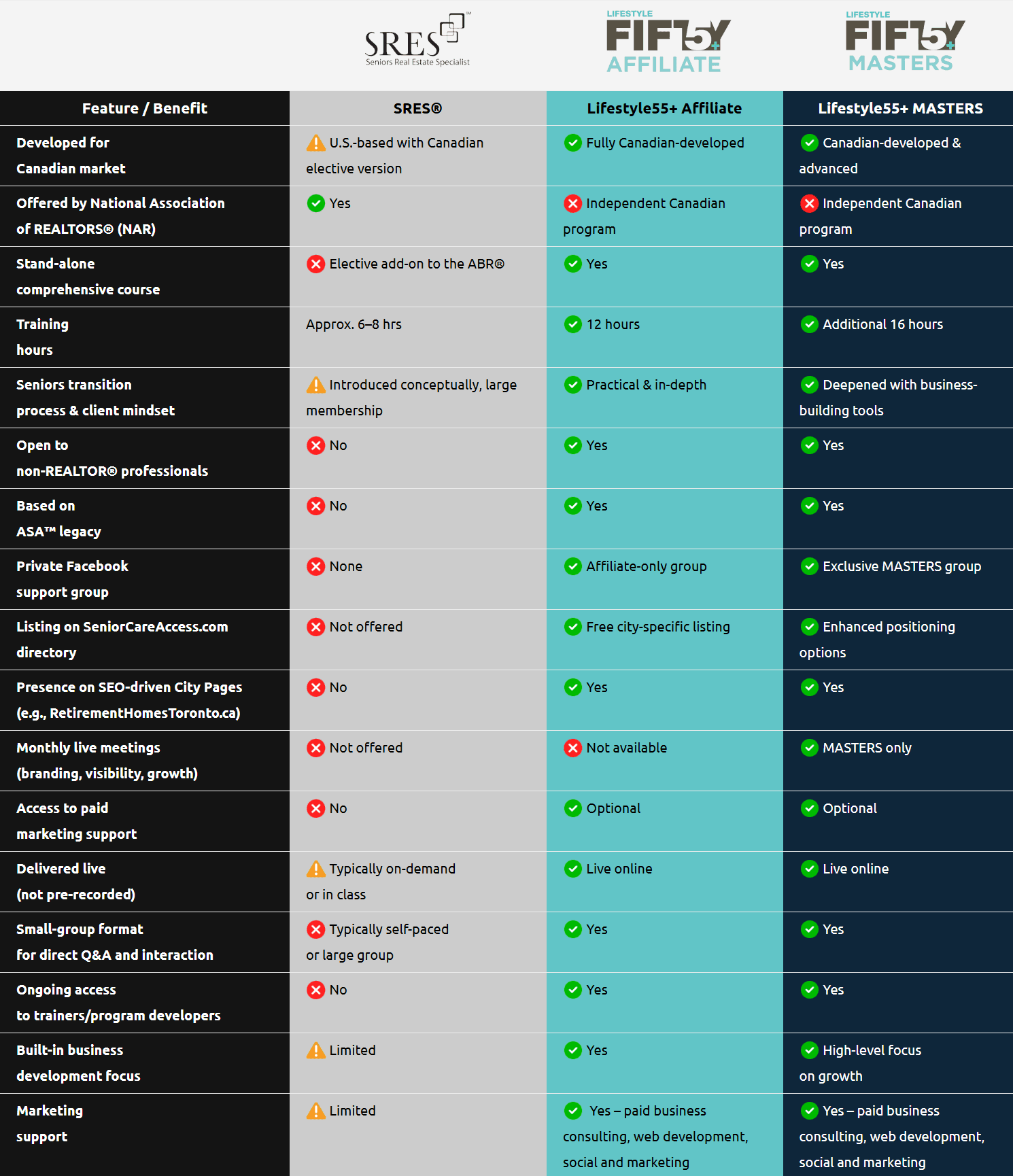
6) I already have the SRES®. Why would I still take Lifestyle55+ Affiliate?
Because Lifestyle55+ Affiliate was built for the Canadian market and from a broader senior-transition point of view.
Yes, we focus this toward REALTORS®, but the program was designed through experience in real estate, senior consulting, executor involvement, home care, senior housing, social work, and marketing.
The SRES® designation has value and name recognition. For some professionals, it is a good starting point. But many Canadian REALTORS® still feel there is a gap between a designation and the real-life issues older Canadians and their families are facing here at home.
Lifestyle55+ Affiliate was an iteration of the original Accredited Senior Agent™ program after acquiring and retiring ASA™. It was specifically created with Canadian realities in mind. It is also shaped by direct experience in senior transitions, family decision-making, later-life housing conversations, executor issues, and the practical side of serving this demographic in a more human and informed way.
It is also the only seniors real estate course that includes the Personal Fiduciary Certificate as part of registration. The Personal Fiduciary Certificate helps participants better understand ethics, duty of care, and the responsibilities tied to roles such as Power of Attorney, Executor, and Trustee. That matters because these conversations and realities often show up around older adult clients and their families.
This is not about attacking another program. It is about recognizing that one course may give you a designation, while another may deepen your relevance, your awareness, and your connection to the real market you want to serve.
Some people take Lifestyle55+ Affiliate because they have no prior seniors training. Others take it because they do, and they still want something more grounded, more Canadian, and more practical.
For many professionals, taking both can be worthwhile.
7) Is it easy to build a seniors-focused real estate business?
No, not instantly.
Like any niche or business, it takes time to build credibility, visibility, trust, and referral relationships. You are not just selling real estate services. You are building a reputation around understanding a very personal stage of life.
That means this is not typically a quick-hit marketing play. It is often a slower, trust-based business model. Families may watch you for months before calling. Professionals may need to see consistency before referring. Older adults may need repeated exposure before they feel comfortable reaching out.
The good news is that this kind of business can become very meaningful and very sticky once your positioning is clear. People remember the professional who understands their world. They remember the one who did not rush them, did not oversimplify things, and knew how to guide a more complicated conversation.
So no, it is not always easy. But it can be valuable, lasting, and deeply worthwhile.
8) Will this course help me compete in a market shaped by younger, more tech-savvy agents?
Yes, but probably not in the way you might first think.
This course is not a tech tutorial. It is not designed to turn someone into a social media influencer or a digital marketing expert overnight. What it does do is help you compete where many younger or more tech-heavy agents may still be weak: understanding the client, the family, the emotional context, and the decision-making process.
Technology matters. But trust still matters more.
A highly polished agent with great video skills and automation tools may still struggle if they do not understand how to speak with a hesitant 78-year-old homeowner, an overwhelmed daughter, or a family dealing with care decisions. In that sense, wisdom, patience, communication, and awareness can absolutely be competitive strengths.
At the same time, the course can help you think more clearly about how to combine your personal strengths with a smarter market position. You do not need to win by being the youngest. You need to win by being relevant, prepared, and credible to the audience you want to serve.
9) Why would I maintain an annual Lifestyle55+ membership?
Because a course can start the process, but staying connected helps keep it alive.
For many professionals, the learning is only one part of the value. Ongoing membership can help reinforce identity, credibility, community, and visibility. It can also create a stronger sense of commitment to the niche, which matters if you want this to become a real part of your business and not just an idea you once explored.
Membership can support you in practical ways too. It can help you stay connected to the Lifestyle55+ network, maintain your profile and positioning, and continue benefiting from the presence and brand association that comes with the community.
Most importantly, annual membership can help prevent drift. Many professionals take a course, feel inspired for a few weeks, and then slide back into general practice. Membership helps keep the niche visible in your business, your mindset, and your marketing. Membership also gives you access to communications, webinar invitations, marketing, online meetings, the searchable members directory, and the use of Lifestyle55+ references.
10) Are there other business opportunities I could develop by working in the 55+ market?
Yes, absolutely.
That is one of the biggest missed opportunities in this space. Seniors real estate is not only about listings and buyer representation. It can lead to stronger referral relationships and related opportunities connected to downsizing, home preparation, aging in place, senior housing transitions, family consulting, estate-related situations, executor support, and trusted local service introductions.
The 55+ market is often relationship-rich. Once you become known as someone who understands this stage of life, you may find opportunities opening beyond the immediate transaction. That could include educational events, partnerships with senior-serving professionals, referral ecosystems, community positioning, content creation, and a stronger long-term niche identity.
The point is not to chase everything. The point is to recognize that this market often reaches wider than people first assume. When you understand the client journey more fully, you begin to see how many surrounding needs and business pathways exist.